CAS CS 237S - Probability in Computing - Summer 2026
Course Staff
| Instructors | Prof. Tiago Januario |
| Teaching Assistant | Yoon Oh |
Communication and Office hours
- Piazza is the primary platform for all online discussions, questions, and answers.
- Use private posts for sensitive or specific questions regarding your solutions or personal matters.
- Do not send emails to the course staff.
- We aim to maintain a positive and inclusive atmosphere on all course platforms.
- If you need special accommodations or are facing unusual circumstances during the semester, please reach out to an instructor privately via Piazza as early as possible.
- For accommodations, forward relevant documentation from Disability and Access Services.
- Your suggestions for improving the course are always encouraged and appreciated.
- Use this link to book online meetings.
- Check our Google Calendar for our walk-in office hours.
Prerequisites
We assume good working knowledge of elementary set theory and counting, elementary calculus (i.e., integration and differentiation), and programming in Python.
Syllabus
Introduction to basic probabilistic concepts and methods used in computer science. Develops an understanding of the crucial role played by randomness in computing, both as a powerful tool and as a challenge to confront and analyze. Emphasis on rigorous reasoning, analysis, and algorithmic thinking. This course fulfills a single unit in each of the following BU Hub areas: Quantitative Reasoning II, Critical Thinking.
Course structure
Given our small cohort of students, this summer session emphasizes active learning, peer discussion, and hands-on problem solving.
- Flipped Classroom: The students are expected to complete the assigned readings from the textbooks before arriving at class.
- Collaborative Workshops: Instead of traditional lectures, class time will be structured as collaborative workshops. Students will work alongside their peers to solve the problem sets in class.
- Device-Free Environment: To foster pure problem-solving and peer collaboration, laptops, tablets, and cellphones are strictly prohibited in classrooms.
- Discussion Sections: Discussion sections will be used for quiz administration, review, and the teaching assistant will demonstrate how to solve long problems. Besides, you can gain bonus points.
- Post-Class Materials: Slides summarizing the core concepts will be made accessible to you after the class concludes to serve as a review tool.
- Attendance: Attendance and active participation in these workshops are mandatory to succeed in the course.
Textbooks
You can access both books for free or support the authors by purchasing the books.
- (P) Introduction to Probability, Statistics, and Random Processes by Hossein Pishro-Nik.
- (LLM) Mathematics for Computer Science by Eric Lehman, Tom Leighton, and Albert Meyer.
- (CLRS) Cormen, Leiserson, Rivest, and Stein. Introduction to Algorithms, Fourth Edition, MIT Press.
Schedule
The schedule below outlines the progression of topics. Please complete the listed readings before attending the corresponding collaborative workshop. Reading chapters are from the first textbook (LLM) or from the second textbook (P), referred to by the acronyms of the author names.
This schedule is subject, and likely, to change as we progress through the semester.
| Date | Agenda (Topics, Readings, Homework) |
|---|---|
| Tuesday May 19 |
Course information Tips to succeed Random experiments Sample spaces, events Do: Meet and greet, workshop 01 |
| Wednesday May 20 |
Probability function Symmetry Probability axioms Do: workshop 01 continues |
| Thursday May 21 |
Probability rules Computing probabilities Do: workshop 01 submission on Gradescope Discussion: Quiz 1 |
| Tuesday May 26 |
Tree diagrams The Monty Hall problem Do: workshop 02 out |
| Wednesday May 27 |
Continuous Probability Spaces Anomalies with Continuous Probability Do: workshop 02 submission on Gradescope |
| Thursday May 28 |
Random variables Sum of random variables Definition and examples |
| Friday May 29 |
Distribution Functions: PDF and CDF Do: workshop 03 submission on Gradescope |
| Monday June 1 |
Properties of PDFs and CDFs Functions of random Variables hw04 out
Do: workshop 04 out
|
| Tuesday June 2 |
Conditional Probability
Pr(⋅ ∣ 𝐸) is a probability function Conditional Probability in Tree Diagrams hw05 out
Do: workshop 04 submission on Gradescope
|
| Wednesday June 3 |
Product Rule Law of Total Probability (generalization) Bayes’ Rule Do: workshop 05 out |
| Thursday June 4 |
Independent Events Independence for Multiple Events People v. Collins Do: workshop 05 submission on Gradescope Discussion: Quiz 3 |
| Monday June 8 |
Independence for Random Variables Expected value of a random variable Do: workshop 06 out |
| Tuesday June 9 |
Linearity of Expectation |
| Wednesday June 10 |
Linearity of expectation Law of the unconscious statistician Do: workshop 07 out |
| Thursday June 11 |
Conditional expectation Linearity of conditional expectation Law of total expectation |
| Monday June 15 |
Variance Standard deviation Variance properties Do: workshop 08 out |
| Tuesday June 16 |
Discrete distributions: - Bernoulli, - Uniform, - Binomial |
| Wednesday June 17 |
Discrete distributions: - Geometric and its properties - Coupon collector's problem Do: workshop 09 out |
| Thursday June 18 |
Reservoir sampling Negative Binomial |
| Monday June 22 |
Markov inequality Chebyshev inequality Applications of Markov and Chebyshev's inequalities Do: workshop 10 out |
| Tuesday June 23 |
Continuous Uniform Distribution Normal distribution Do: workshop 10 submission on Gradescope |
| Wednesday June 24 |
Exponential distribution Poisson Process Poisson Distribution Do: workshop 11 out |
| Thursday June 25 |
Central Limit Theorem Law of Large Numbers Do: workshop 11 submission on Gradescope Discussion: Quiz 6 |
In-Class Deliverables
- Traditional weekly take-home assignments are replaced by in-class collaborative problem sets.
- Content: You must provide step-by-step explanations for your answers during the workshop. Submissions with only answers will receive minimal credit.
- Partial Submissions: Submitting partial work is acceptable if you cannot fully complete an assignment; avoid missing the deadline entirely.
- The instructors retain the right to oral explanation of any student work submitted for a grade. If the student cannot explain the work they have submitted, the instructor will assign a grade of 0 on the entire assignment in question.
- Your lowest in-class deliverable score will be dropped to give you leeway in an emergency situation.
Quizzes
To ensure you are keeping up with the flipped classroom model, this course replaces traditional high-stakes midterms and final exams with frequent quizzes.
- Quizzes's dates are given in the course schedule.
- These quizzes will be based on the required pre-readings, workshop problem sets, and flashcards.
- Quizzes will be administered during the discussion sections. No collaboration whatsoever is permitted, any violation will be reported to the College.
- We use Anki for flashcards. You can download their free app to access them. We will also post the flashcards in plaintext if you prefer to print them out.
- The content of the quizzes is cumulative.
- Your lowest quiz score will be dropped to give you leeway in an emergency situation.
Grading
This course uses a cumulative grading system based on a total of 1050 points. The fixed point distribution below guarantees your minimum letter grade based on the total points you accumulate throughout the summer session. Active participation and attendance are inherently required to earn the points for the in-class collaborative deliverables.
The total 1050 points will break down as follows:
- 400 points for In-Class Deliverables (Collaborative Problem Sets)
- 600 points for Quizzes (Individual Assessment)
- 50 points for discussion section participation
Letter Grade Distribution
| Letter Grade | Point Range |
|---|---|
| A | 900+ |
| A- | 850 – 899 |
| B+ | 800 – 849 |
| B | 750 – 799 |
| B- | 700 – 749 |
| C+ | 650 – 699 |
| C | 600 – 649 |
| D | 550 – 599 |
| F | <= 549 |
Regrade Policy
- Regrade requests can be submitted up to 48 hours after grades for a given assignment have been posted.
- You must request a regrade via Gradescope, NOT through email.
- When we regrade a problem, your score may go up or down.
AI Policy
- Because workshops are strictly device-free, you will not have access to AI tools during class.
- Outside of class, you may use large language models like ChatGPT or Gemini to help clarify concepts, discuss problems after the workshop has concluded, or review past material.
- Be wary, though, of hallucinations. It is good to double check any information you receive from LLMs with a reliable source.
FAQ
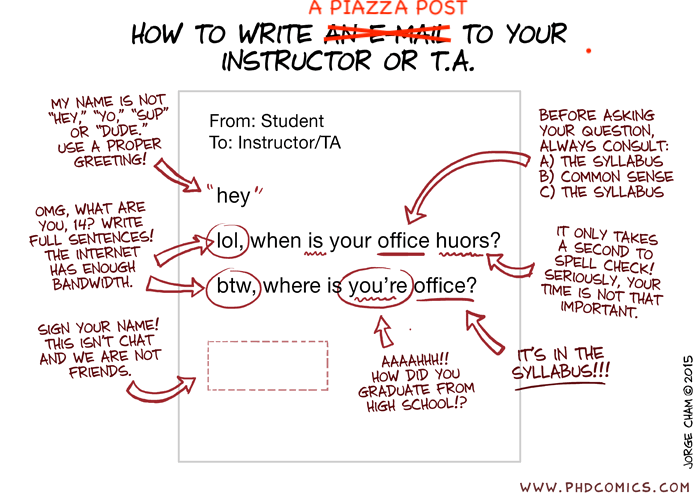
Many common questions have already been answered. Before emailing, posting on Piazza, or asking in class, please try the following:
- Start with the syllabus. It answers an impressive number of questions about deadlines, policies, office hours, and grading. If you’re still unsure, feel free to consult an LLM. Copy-pasting the syllabus and asking “What is the policy on X?” is often faster than waiting for a reply—and helps keep Piazza focused on course content.
- The course is taken as designed. Assignments and deadlines apply uniformly to everyone, except where formal accommodations are documented. See #1.
- Missed a class? Something important was probably covered. Please check the posted materials and ask a classmate before reaching out. See #1.
- Dates and deadlines have been posted since Day 1. Keeping track of them is part of the course. See #1.
- Office hours exist! They’re a great place for questions about concepts, feedback, or anything not already answered in the syllabus. See #1.
- Extensions are not granted. Instead, we waive the missed assignment with the lowest score. It is always better to submit an incomplete work than nothing at all. See #1.
Reading the syllabus (or asking an LLM to summarize it for you) will save everyone time—including yours. See #1.